Mobile home plumbing follows the same physics as any house, water in under pressure and waste out by gravity, but almost every practical detail is different. The pipes run under the floor instead of inside the walls, the home was inspected at a factory instead of by a city inspector, and the pipe sizes are often a step smaller than a plumber expects to find. Those three differences decide how you diagnose a problem, what a repair costs, and how fast a small drip turns into a soft floor.
What Type of Plumbing Is Used in Mobile Homes
Manufactured homes have used nearly every plumbing material of the last fifty years, and many homes contain two or three at once after decades of patch repairs. PEX showed up in manufactured housing well before it became standard in site-built construction, so a 1990s single wide can have newer tubing than a 1990s stick-built house.
Here is what you are likely to find under your floor.
| Material | Typical service life | Hot, cold, or drain | How to identify it | Repipe candidate? |
|---|---|---|---|---|
| PEX | 25 to 40 years (manufacturer estimate) | Both | Flexible; red, blue, or white; crimp rings | No |
| CPVC | 30 to 50 years | Both | Rigid, cream or tan, glued joints | Only if brittle or cracking |
| PVC | 40+ years | Cold and drain | Rigid white, glued joints | No |
| ABS | 40+ years | Drain only | Rigid black, glued joints | No |
| Poly (PE) | Varies widely | Cold, buried runs | Black, coiled, barbed fittings with clamps | Only where leaking |
| Copper | 50+ years | Both | Rigid metal, soldered joints | No |
| Galvanized steel | 40 to 60 years, often past it | Both | Dull gray metal, threaded joints, rust at threads | Yes |
| Polybutylene | Installed roughly 1978 to 1995 | Both | Flexible gray, cream, or blue plastic | Yes |
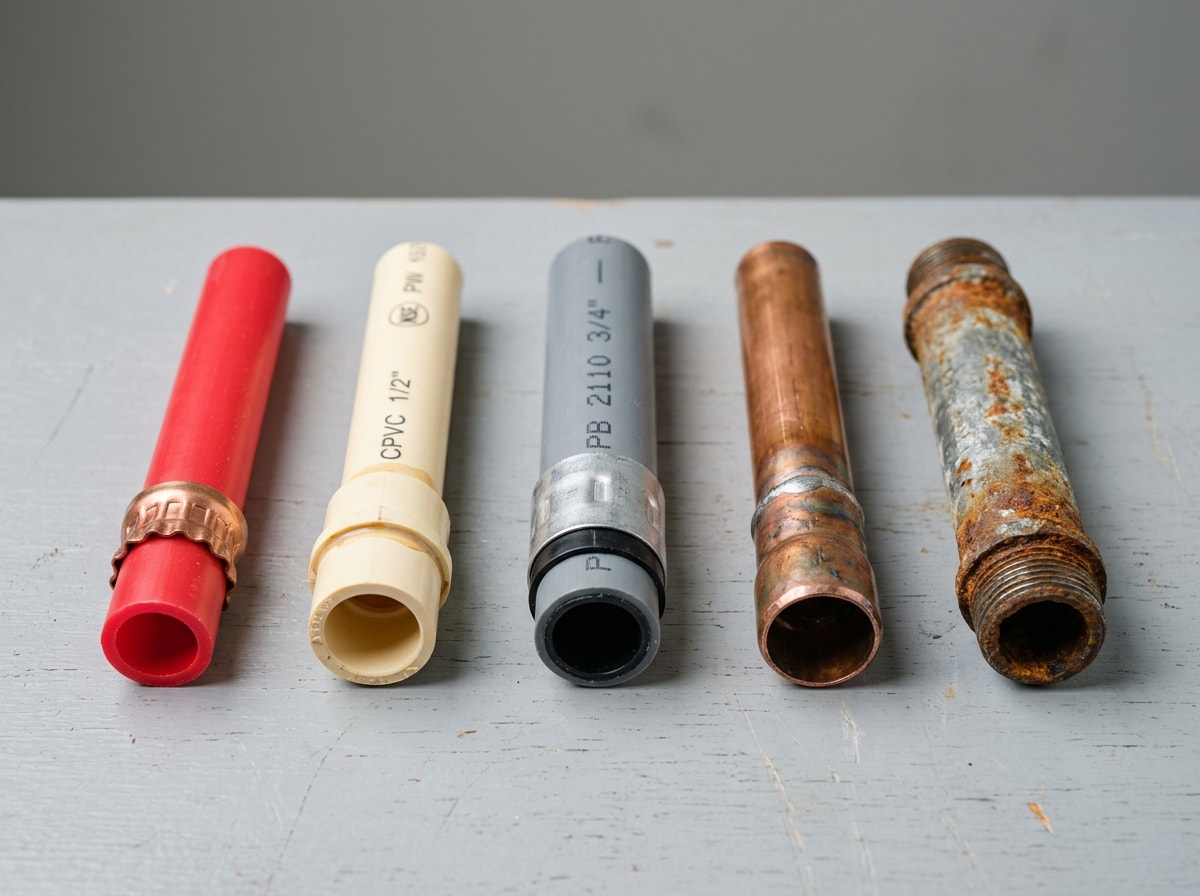
One identification tip worth knowing: if your supply pipe is flexible plastic in white, cream, or medium gray with metal or plastic crimp bands, it may be polybutylene. That material has a poor reliability record, and it is the first thing to check in an older home.
Treat polybutylene and galvanized steel as replace on discovery. Everything else gets repaired on its own merits.
Where Mobile Home Plumbing Pipes Are Located
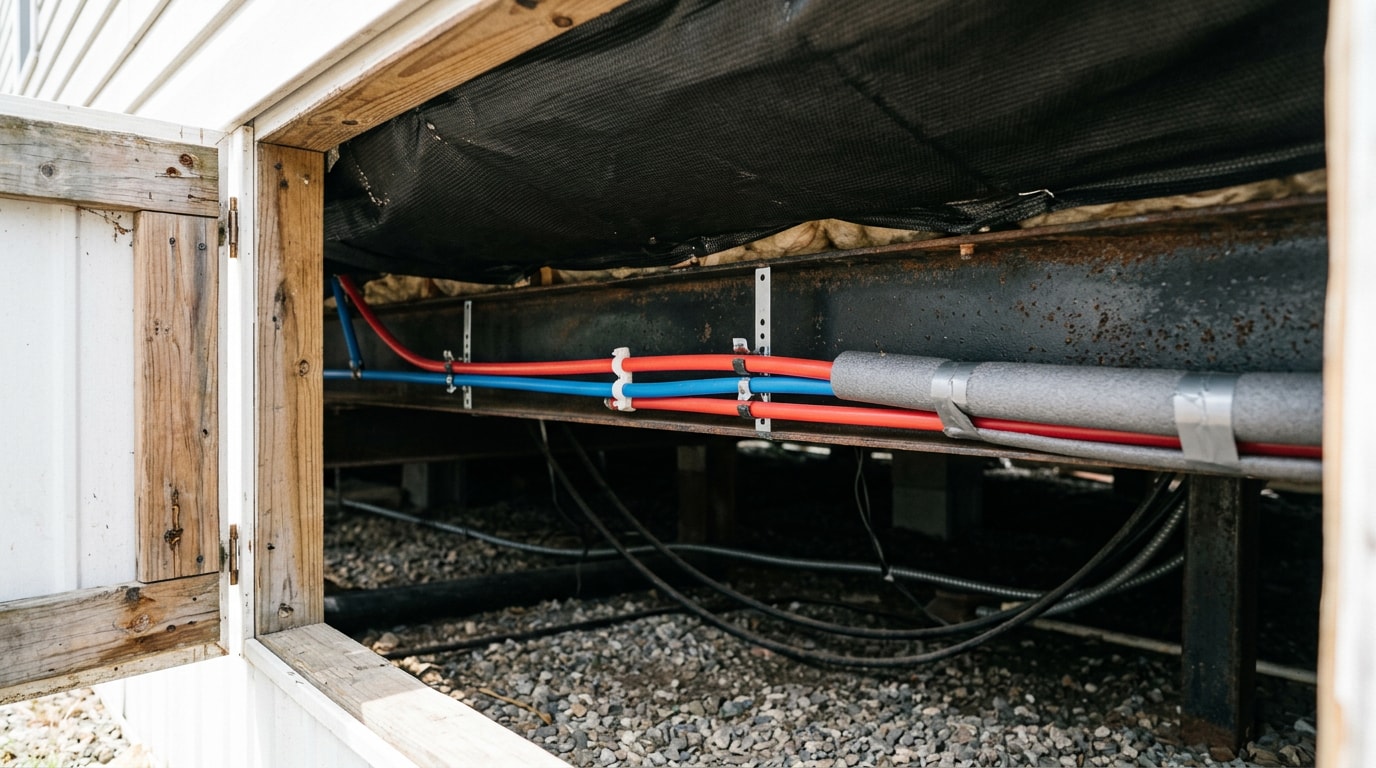
In a manufactured home, the plumbing runs horizontally under the floor inside the belly, the insulated cavity between the floor decking and the belly board.
Supply lines are stubbed up through the floor at each fixture, so you rarely see a pipe until it reaches a sink or toilet.
Routing usually follows one of two paths. Many homes run the lines alongside the heating ducts to borrow warmth. Others push them to one side, depending on where the water heater sits.
That layout has real consequences:
- Fewer access points, so finding a leak means crawling under the home and opening the underbelly.
- The belly wrap has to be resealed properly afterward, because a torn wrap invites moisture, rodents, and sagging insulation.
- Exposed lines freeze faster than lines inside a wall, which is why intact skirting matters so much in a cold snap.
Utah State University Extension notes that unprotected water lines exposed to freezing temperatures for several hours will freeze, expand, and crack, with the real damage arriving later when the line thaws under pressure. See their advice on preventing frozen pipes before winter, not during it.
A pinhole leak inside the belly can soak insulation for weeks before a soft floor or a jumped water bill gives it away. If you suspect one, our leak detection crews locate it before anyone cuts the wrap open. (Correct link: leak detection.)
How Mobile Home Plumbing Differs From a Site-Built House
It Was Built to the HUD Code
Manufactured homes built after June 1976 are constructed to a federal standard rather than the local residential code that governs stick-built houses. Subpart G of that standard covers the plumbing materials, fixtures, and equipment installed within or on manufactured homes, with the stated intent of producing water supply, drain, waste, and vent systems that function safely .
Here is a detail most homeowners never hear: the federal standard caps fixture flow. Under the HUD code, lavatory faucets, showerheads, and sink faucets must not exceed a flow of 2.5 gallons per minute . You can read the rule text in 24 CFR Part 3280, Subpart G.
Why that matters in practice: swapping in a bigger showerhead almost never fixes weak pressure in one of these homes. The restriction is usually upstream, in the supply line size or a partially closed valve, not at the fixture.
The other practical upshot is jurisdictional. The original build answers to the federal standard, but repairs, replacements, and the water and sewer hookup at your lot may still fall under local rules. Check before you start a big job.
The Pipes Are Smaller
Supply pipe in these homes typically runs 3/8 inch to 1 inch, with the smaller diameters feeding individual fixtures. Many builders also install a 3 inch drain line where a site-built house would use 4 inches, and vent diameter follows the same pattern.
Undersized vent pipe causes as much trouble as undersized waste pipe. Both show up as the symptoms homeowners actually notice: weak pressure at the tap, gurgling, and drains that empty slowly even when the slope is fine.
The Three Parts of a Mobile Home Plumbing System
Every system has three parts: pressurized supply lines bringing fresh water in, gravity fed drain waste lines carrying wastewater out, and vent lines balancing air pressure so the drains can flow.
They work as one loop, which is why a fault in one part often surfaces as a symptom somewhere else.
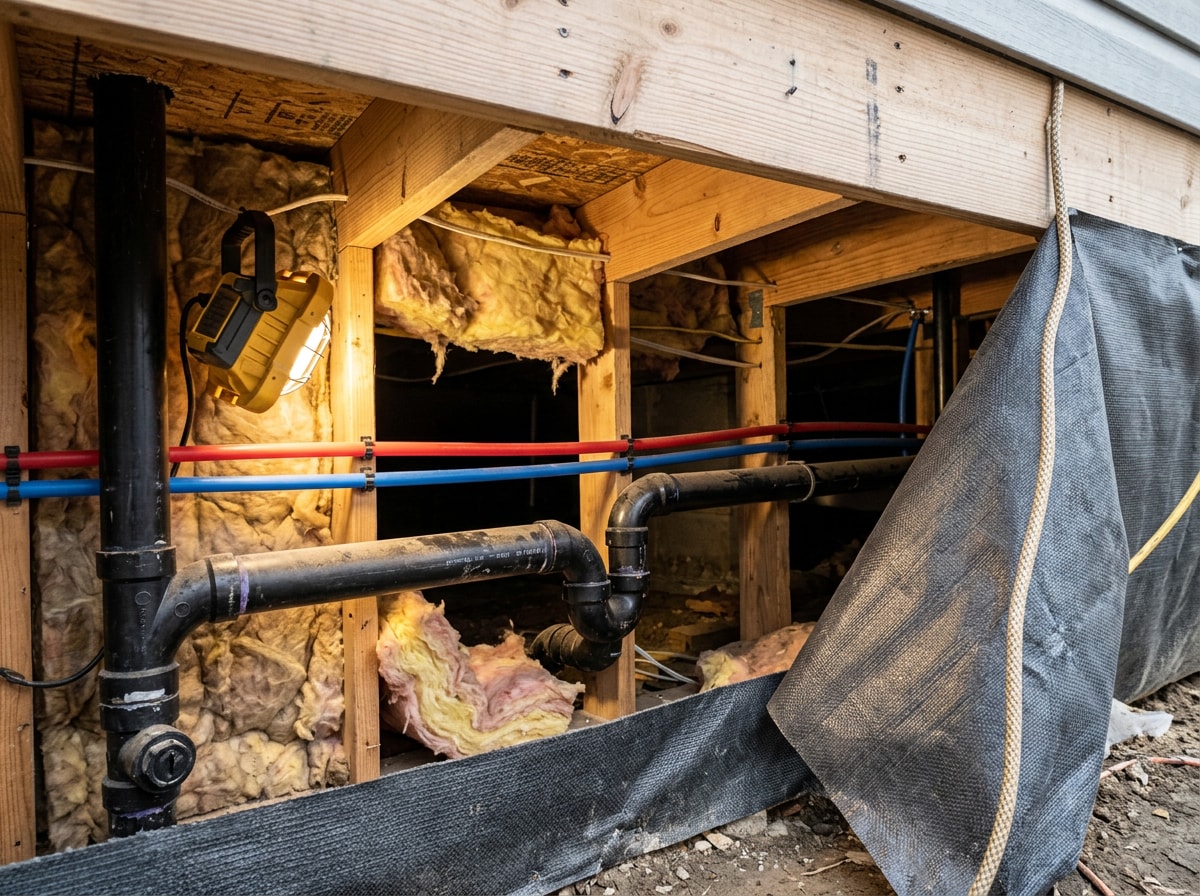
Water Supply Lines
The main water line enters through the floor or the rim and immediately splits.
One branch stays cold and runs to fixtures. The other feeds the water heater, then returns as the hot line.
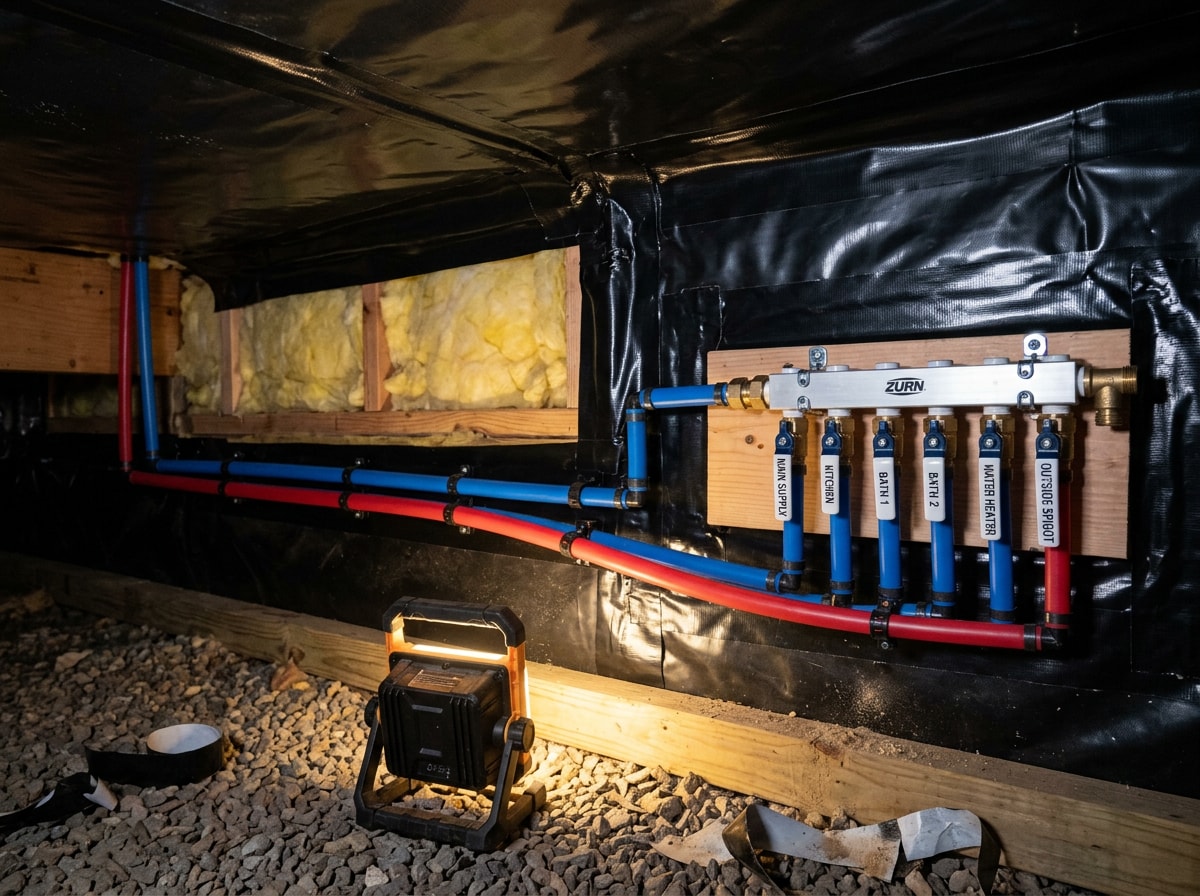
From there, hot and cold lines travel in parallel under the floor to every sink, tub, toilet, and appliance. Most modern homes use PEX, which tolerates a freeze better than rigid pipe, though not indefinitely. When one of those runs splits, burst pipe repair is the emergency, but the water heater connections are worth checking at the same visit through water heater repair.
Drain Waste Lines
Drain waste lines do not use pressure. Wastewater moves because the pipe is pitched downhill toward the sewer drop, the point where the main waste line exits the belly and connects to the park sewer, municipal line, or septic tank.
Every fixture sits above a P trap, the U shaped bend holding a small pool of standing water. That water seal is the only thing blocking sewer gas from rising back through the drain. When a trap dries out from disuse, odor follows within days.
Waste lines run larger than supply lines, commonly 1.5 to 3 inches, and are usually black ABS or white PVC joined with solvent cement.
Vent Lines
Vents carry air, not water. Each time a fixture drains, the departing water pulls a vacuum behind it, and the vent lets outside air in to replace it so waste keeps moving instead of stalling or siphoning traps dry.
Vent pipes run up through the roof and terminate in a cap. When one is blocked by a bird nest, debris, or a crushed pipe, the signs are consistent: glugging toilets, slow tubs, and a sewer gas odor that comes and goes with use.
Common Mobile Home Plumbing Problems
Tight routing and limited access let a small problem escalate fast. Use this table to narrow down what you are actually dealing with before you start pulling panels.
| Symptom | Most likely cause | First thing to check |
|---|---|---|
| Weak pressure at one fixture | Clogged aerator or partly closed stop | Unscrew and rinse the aerator |
| Weak pressure everywhere | Main supply restriction, failing pressure regulator, or old galvanized pipe | Main shut off valve position, then pipe material |
| Gurgling drains, phantom odor | Blocked or crushed vent | Roof vent cap for nests and debris |
| Tub backs up when toilet flushes | Main waste line blockage | Stop using water, call for main line clearing |
| No water on a cold morning | Frozen line under the belly | Skirting gaps, heat tape plugged in |
| Warm, damp floor spot | Hot line leak inside the belly | Water meter with all fixtures off |
Slow and Clogged Drains
Hair and soap scum choke bathroom drains. Grease and food debris choke kitchen ones. Both start as a slow drain long before they stop completely, which is your window to act cheaply.
Use the right plunger, a flange plunger for toilets and a flat cup plunger for sinks and tubs, and seal the overflow opening so you build actual pressure. Cheap mesh drain covers prevent most of it.
Go easy on chemical drain cleaner. Repeated use generates heat that can soften aging plastic pipe, and in a home with 3 inch drain trunks there is not much margin for a damaged section. Persistent blockages are a job for drain cleaning and unclogging with a cable or camera, not a second bottle.
Small leaks are not a small issue either. EPA reports that the average household's leaks account for more than 9,300 gallons of water wasted every year, and nine percent of homes have leaks wasting 50 gallons or more per day . The agency's Fix a Leak Week resources include the two hour meter test, which works just as well on a manufactured home as on a slab house.
Main Waste Line Clogs and Backups
A clog in the main waste line is a different animal. The sewer line runs inside the belly with few access points, so clearing it usually means working from the exterior cleanout or opening the underbelly.
If wastewater backs up into a tub or shower when you flush, stop using water and call for help. That pattern points to a blockage downstream of every fixture, and continued use just spreads contamination. A sewer camera inspection tells you whether you are looking at a soft blockage or a collapsed section that needs sewer line repair.
Cleanouts and Shut Off Valves
Older manufactured homes are notoriously short on cleanouts and fixture shut offs. Many have no fixture valves at all, which means a dripping toilet supply forces you to kill water to the whole home. Newer builds usually include valves at each fixture.
The cleanout you do have is often outside, a capped vertical pipe near where the main waste line meets the sewer trunk or septic connection.
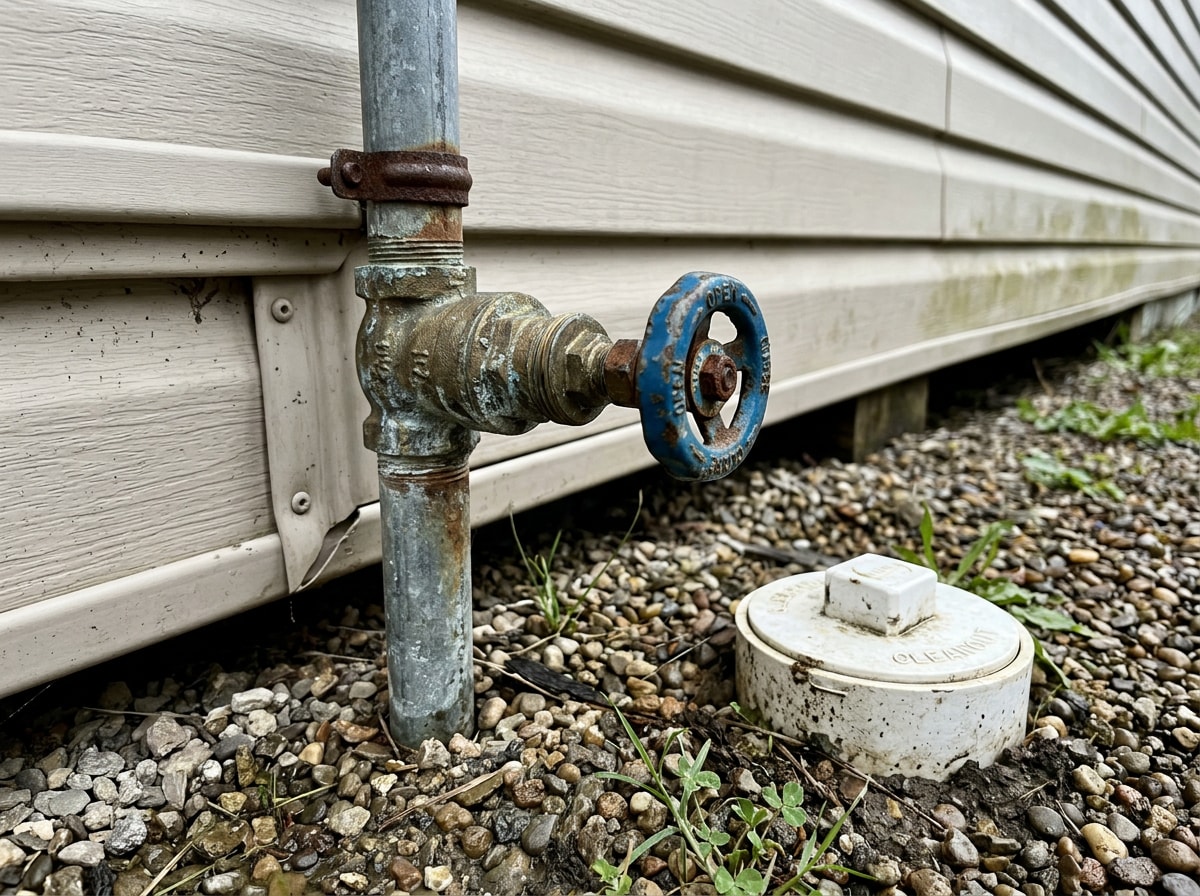
Do this before you need it: find your main water shut off, turn it fully closed, and turn it back open.
A seized valve discovered during an emergency is a far worse problem than a stiff one discovered on a Saturday afternoon. In our own field work across West Texas, the single most common reason a small belly leak becomes a floor replacement is that nobody could find or turn the main valve for twenty minutes.
If that valve is already weeping or will not seat, plumbing repair on the valve is a same day job. A failure at 2 a.m. is what emergency plumbing is for.
What a Mobile Home Repipe Involves
Repipe pricing swings hard by region, home size, and access, and published estimates range from a modest single fixture fix to several thousand dollars for a whole home. Get local bids rather than trusting a number online.
Scope drivers to ask any bidder about:
- Single wide versus double wide, and how many fixture groups
- Replacement material, usually PEX
- Whether the belly wrap gets properly resealed or just taped
- Floor and insulation repair after the work
- Whether the water heater connections and shut offs get replaced at the same time
Partial work is often the smarter buy. Replacing only the failed runs with pipe repair and replacement makes sense when the rest of the system is PEX or CPVC in good shape. Go to whole-home repiping when the home still has polybutylene or rusted galvanized steel throughout.
If you are sourcing your own fittings for a partial job, our guide on choosing a wholesale plumbing supplier covers what to ask before you buy.
DIY Repairs vs. When to Call a Plumber
Plenty of mobile home plumbing work is genuinely homeowner friendly:
- Shutting off the main water valve
- Plunging a sink, tub, or toilet
- Replacing a braided supply hose or a toilet flapper
- Heat taping and insulating exposed lines before winter
- Clearing a P trap under a sink
- Rinsing a clogged faucet aerator
Hand these to a licensed plumber:
- Main line clogs and sewer backups
- Full or partial repipes
- Any repair that requires cutting and resealing the belly wrap
- Water heater replacement, gas connections, and relief valve work
- Persistent low pressure with no obvious cause
One filter matters more than price: ask whether the plumber has worked on manufactured homes specifically. Access, fittings, and pipe sizes differ enough that experience shows up in the invoice. You can see examples of completed work on our projects page, and 1213 Plumbing covers Lubbock and the surrounding communities.
Not sure which category your problem falls into? Request a quote and start with a diagnosis instead of a guess.
FAQ
What type of plumbing is used in mobile homes?
Most modern manufactured homes use PEX or CPVC for water supply and PVC or ABS for drain waste. Homes built before the mid 1990s may still have polybutylene, galvanized steel, or copper supply lines, and the first two are worth replacing on discovery.
Where are the water pipes in a mobile home?
They run horizontally under the floor inside the belly, the insulated cavity between the floor decking and the belly board, then stub up through the floor at each fixture. Very little supply pipe runs inside wall cavities.
Where is the main water shut off in a mobile home?
Usually outside near the water riser or just inside the skirting where the supply line enters, and sometimes in a utility closet near the water heater. Find and exercise it once a year so it is not seized when you need it.
How much does it cost to replace plumbing in a mobile home?
Published contractor estimates range from a few hundred dollars for a partial run to several thousand for a whole home repipe. Cost drivers include single versus double wide, pipe material, access difficulty, and belly and floor repair afterward. Figures shift by region and year, so collect local bids.
Can you use standard plumbing parts in a mobile home?
Some parts yes, some no. Faucets and most drain fittings are interchangeable, but supply pipe diameters, tub and shower units, and many toilets are sized for manufactured housing and use different rough in dimensions. Confirm the fit before you buy.
Why does my mobile home have low water pressure?
Check the aerator first if it is one fixture. If it is the whole home, suspect a partly closed main valve, a restricted supply line, or corroded galvanized pipe. Installing a higher flow showerhead will not solve it, since the federal standard caps fixture flow at 2.5 gallons per minute anyway.
Do mobile homes have plumbing vents?
Yes. Vent pipes run up through the roof and terminate in a vent cap. A blocked vent causes gurgling toilets, slow tubs, and intermittent sewer odor, and it is one of the most commonly missed causes of a slow drain.
What size are mobile home drain pipes?
Branch drains are commonly 1.5 to 2 inches, and the main waste trunk is often 3 inches where a site built house would use 4. Smaller trunks clog faster, which is why kitchen grease is a bigger problem here.
What is a mobile home water pipe diagram?
It is a schematic of your home's plumbing layout showing supply and drain runs, fixture connections, shut off valves, and vent locations. Check your original manufacturer documentation or closing paperwork first. If that is missing, the manufacturer or a plumber can often sketch the layout from the model number on the data plate.